
Why I Give 2% of My Profits to Team for the Planet

En bref
Why I give 2% of Pwablo's profits to Team for the Planet rather than to carbon offsetting, plus concrete pointers for taking action at your own scale.
On 24 June 2026, the thermometer hit 35.1 °C in Uccle: the hottest 24 June in Belgium since records began in 18331,2. By early afternoon, the previous record of 32.8 °C, set on the same day in 1976, had already been beaten2. Heatwaves are no longer distant anomalies: they are now written into the Belgian calendar.
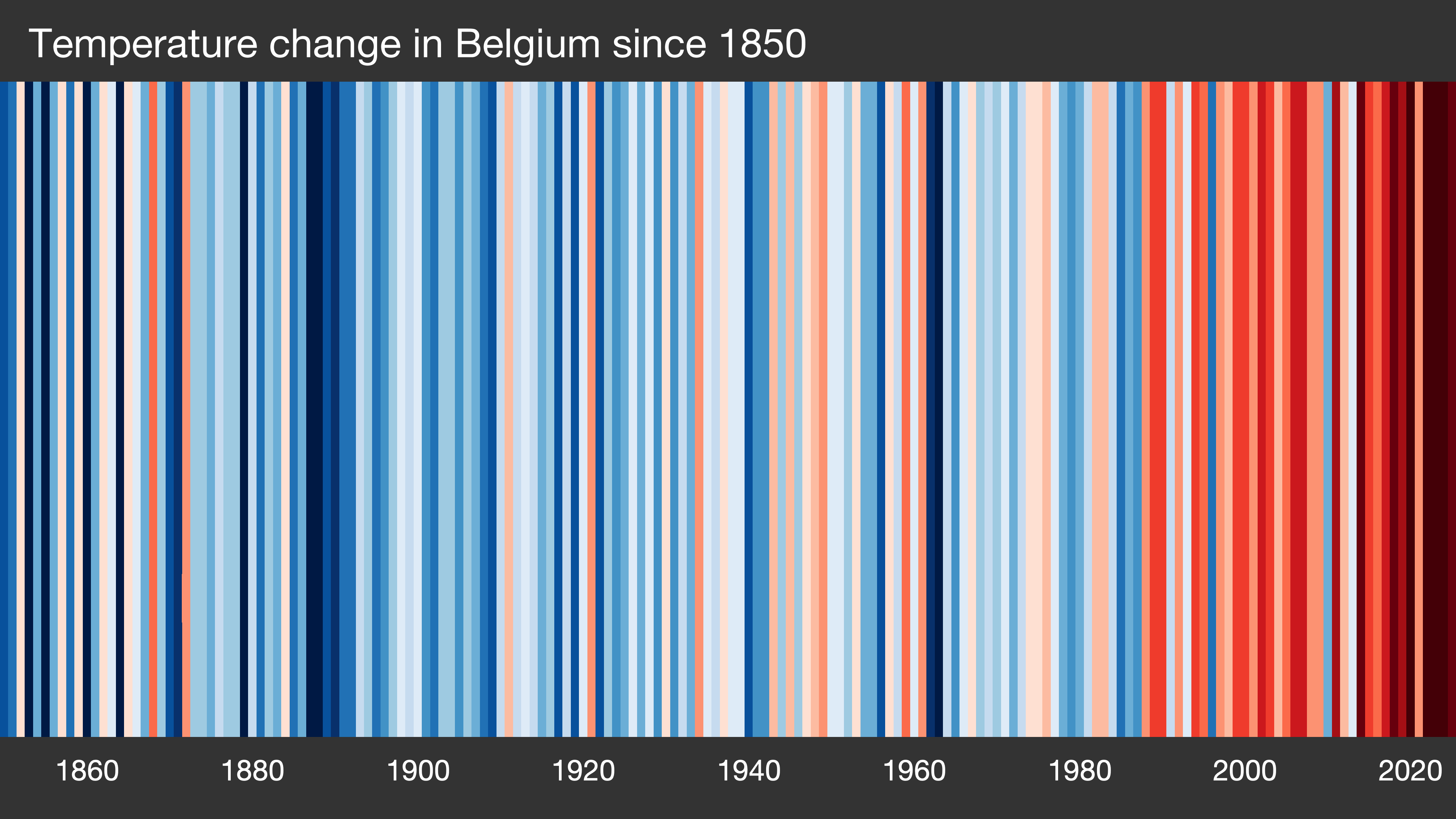
Annual temperature anomaly in Belgium, 1850-2025. Each band is one year. Graphic: Ed Hawkins (University of Reading),
#ShowYourStripes
, licence
CC BY 4.0
.
And temperature is only the first link in a much longer chain. The Intergovernmental Panel on Climate Change (IPCC) documents consequences that reach far beyond the weather: health, agriculture, biodiversity, available resources. In the most exposed regions, these fragilities can also amplify tensions that are already present, particularly around water, arable land or population displacement. These effects are unevenly distributed and very often hit first the regions and populations that contributed the least to the problem9. Workshops such as the Climate Fresk help make this chain of cause and effect tangible.
Faced with this reality, one question quickly comes up: how can we act, even modestly, at our own scale?
I don’t claim to offer a complete answer. But through Pwablo I try to root certain choices in an approach that is consistent with the direction I want to give this activity: more responsible, more frugal technology. Among those choices is giving, for the past year and a half, 2% of net profits to Team for the Planet, a company that funds climate innovations whose developers commit to opening up their use under a free licence, in order to speed up their spread.
The idea is simple: contribute to open, verifiable solutions rather than buy a promise of carbon neutrality that is hard to check.
The Team for the Planet model
Team for the Planet approaches the problem differently. It isn’t a charity: it’s a mission-driven company, structured as a partnership limited by shares (SCA), founded in Lyon in 2019, that collects citizen savings to invest in climate solutions.
This status is no detail. Shareholders receive no conventional financial dividends. The bylaws set a deliberately radical condition: dividends would only become distributable if global warming were to return to its pre-industrial level4. In the meantime, the indicator being tracked is the “climate dividend”: the tonnes of CO₂ avoided thanks to the innovations funded5.
Beyond the rhetoric, it was above all the concrete way it works that guided my decision. Three elements in particular:
- 1 share = €1 invested. No speculative valuation on the way in. The model keeps participation legible: one share, one euro. For a freelancer or a small structure, that simplicity matters.
- Scientific selection. Candidate innovations are assessed by a scientific committee. The aim isn’t to fund the idea that looks most appealing on paper, but the one that combines climate potential, technical feasibility and capacity to be deployed.
- Open use under a free licence. The developers of the innovations funded commit to making their use accessible under a free licence. The patent may still protect the innovation, but a contract opens up its use to speed up deployment, rather than locking down intellectual property.
It’s the same reflex as in open-source software, whose code is public and freely reusable: you trust a solution you can inspect more than a promise you have to take on trust.
What these 2% fund
Principles matter, but they have to be verifiable in concrete terms. Team for the Planet publishes a sheet for each innovation it funds, with the amount invested and the date it entered the capital. Three projects illustrate the approach.
Beyond the Sea: led by sailor Yves Parlier from La Teste-de-Buch. The principle: fit autonomous traction sails, like giant kites, onto merchant marine vessels to cut their fuel consumption. Maritime transport remains a sector that is hard to decarbonise; at that scale, a replicable solution deserves to be evaluated seriously6.

A merchant ship towed by a SeaKite wing. Visual:
Team for the Planet
.
Cool Roof: a reflective paint incorporating recycled oyster-shell powder, applied to roofs to lower the indoor temperature of buildings7. During heatwaves, the benefit becomes very tangible: avoiding part of the reliance on air conditioning can have a direct, local and measurable effect.
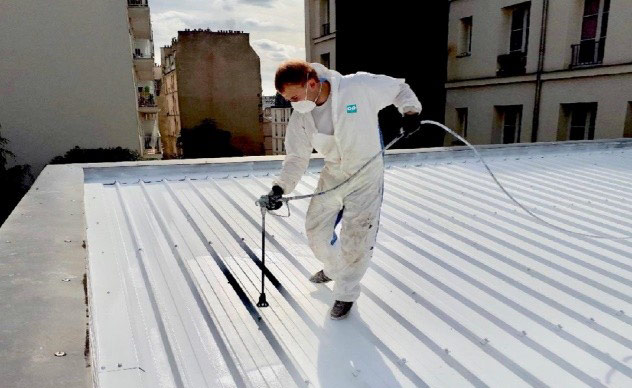
Applying the reflective coating to a roof. Photo:
Cool Roof France
, via
Bretagne Économique
.
Monomeris: formerly Crymirotech, the project works on the chemical recycling of complex plastic waste, including mixed or contaminated streams8. The principle: go back to the monomers, that is, the basic chemical building blocks, to produce new materials without starting solely from fossil resources.

The Monomeris recycling units, designed as containers. Visual:
Team for the Planet
.
These projects aren’t all at the same level of maturity. That’s normal. Team for the Planet funds innovation, not guaranteed outcomes. An essential difference from carbon offsetting lies in the nature of the claim: this investment isn’t presented as cancelling out a past emission, but as a contribution to developing solutions that could avoid emissions elsewhere, and in the future.
A structural choice, not a circumstantial one
That leaves the question of scale. Pwablo is a side activity I run alongside salaried employment. Through it, I help mission-driven organisations with web eco-design, the development of custom applications, process automation and awareness-raising on responsible tech.
The 2% apply to the net profits of this activity. The amount stays modest, but the commitment is renewed each year and moves with the profits actually generated. In concrete terms, it takes the form of a share investment aimed at climate impact, not a donation.
This contribution obviously doesn’t make Pwablo beyond reproach, and it doesn’t offset the impact of its own activity. It simply builds a lasting commitment, alongside the responsible-tech practices carried out within the projects.
The other pillars: where to start?
Of course, technology won’t solve everything. The IPCC reminds us that effective responses combine individual changes, collective transformations and investment choices9: innovation is just one pillar among others.
To pull on these levers without getting lost in an endless list of gestures, one distinction structures the pointers below. On one side, the footprint, what carbon calculators measure. On the other, the “climate shadow” (Emma Pattee, 2021): the influence that numbers capture poorly, your job, your money, your voice. The concept has its limits; it complements the footprint without replacing it.
The 2% bet
Well-selected innovations, funded patiently and made accessible, can accelerate transitions that the market alone would not deliver fast enough. That’s Team for the Planet’s bet, and it’s also the one I’m making at Pwablo’s scale.
These two per cent won’t change the world on their own. But they anchor a contribution over time. More than one hundred and thirty thousand partners make the same choice, each at their own scale10. A single brick stays modest. Assembled, they can end up carrying something bigger.
More information at team-planet.com. And if a climate innovation is gathering dust in your drawers: the 1 million for the Planet contest has just launched, with one million euros of capital investment on offer for each of the three winning projects10.