Automation & Responsible AI SERVICES
We help you lighten your business processes: less data entry, less retyping, fewer oversights. When it brings real value to your work, we integrate artificial intelligence (AI) in a responsible, well-framed way. The software we use is open source, adapted to how you work and stays under your control.

What we can automate
A few examples. We start from your tools and decide with you, case by case, what is worth automating.
Your repetitive tasks
Recording a contact, tracking your services and tasks, filing incoming invoices, scheduling newsletters and posts…
Your documents
An assistant finds information in your procedures, contracts or past files, and points to the passages (RAG).1
Your tools, connected
n8n connects natively to Odoo, HubSpot, Brevo, Google Workspace or Microsoft 365, and to any tool with an API.
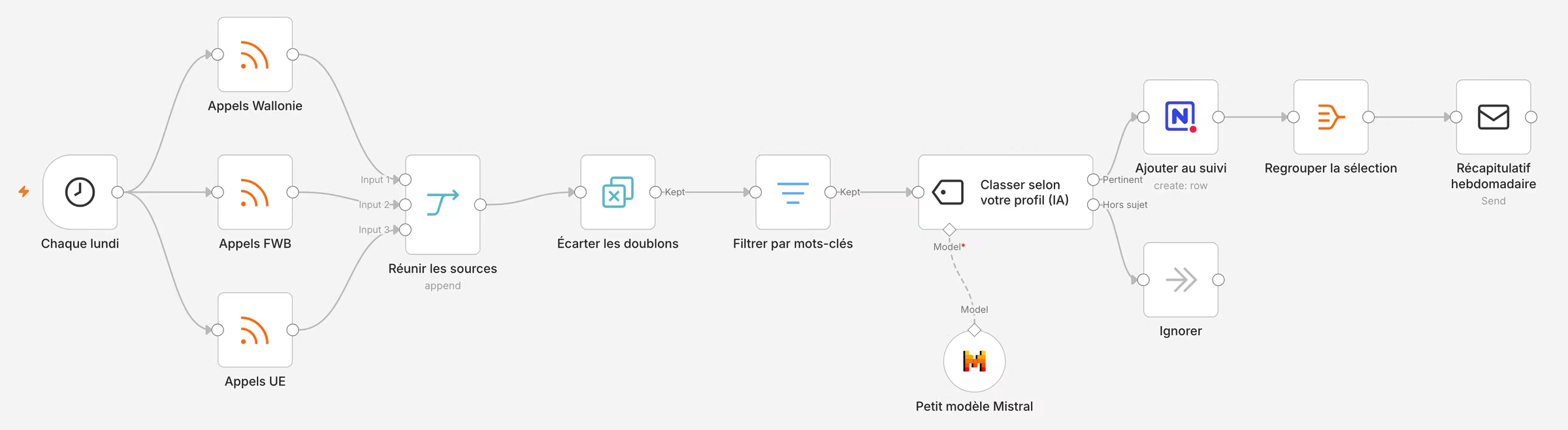
Example: tracking calls for projects and grants
Every week, this flow built with n8n (an open-source automation tool) gathers the calls for projects published by funding bodies. A keyword filter removes most of them, then a small AI model, given a description of your nonprofit, sorts the rest. The leads it keeps go into your tracking tool, with a weekly summary.
Data, security, sobriety
In Europe, or on your premises
Your tools and data hosted in Europe, on a rented server (VPS) or in your offices, including for AI (Mistral, Ollama).
Sized to the need
Open-source tools proportionate to the use, a simple rule when it is enough and, for AI, the most compact model suited to the task.4
How we work together
A structured, five-step approach, carried out with your teams.
-
1. Current situation
Your processes, tools and constraints, described together in plain language.
-
2. Audit and priorities
What is worth automating, what is not, and where to start: a plan decided with you.
-
3. Implementation
Built on your real cases and tested alongside your current way of working before going live.
-
4. Support
Your teams get to grips with the tool. If AI is involved, a workshop and a usage policy set the framework.5,6
-
5. Monitoring and maintenance
Hosting, updates, alerts on errors7 and changes as your needs evolve.
Let’s talk about your processes
Tell us which tasks take up your time and which tools you already use. In a first conversation, we look together at whether automation makes sense, and how to put it in place.
Sources 7
- Chen et al., 2024, “Benchmarking Large Language Models in Retrieval-Augmented Generation”: knowing when to say “I don’t know”.
- EU AI Act, Article 14: human oversight.
- GDPR, Article 22: no fully automated decision that significantly affects a person.
- Luccioni et al., 2023, “Power Hungry Processing”: energy use varies widely with the task and the size of the model.
- Microsoft and LinkedIn, Work Trend Index 2024: 78% of people who use AI at work bring their own tools.
- EU AI Act, Article 50: informing people that they are interacting with an AI system.
- n8n documentation: error handling and execution logs.